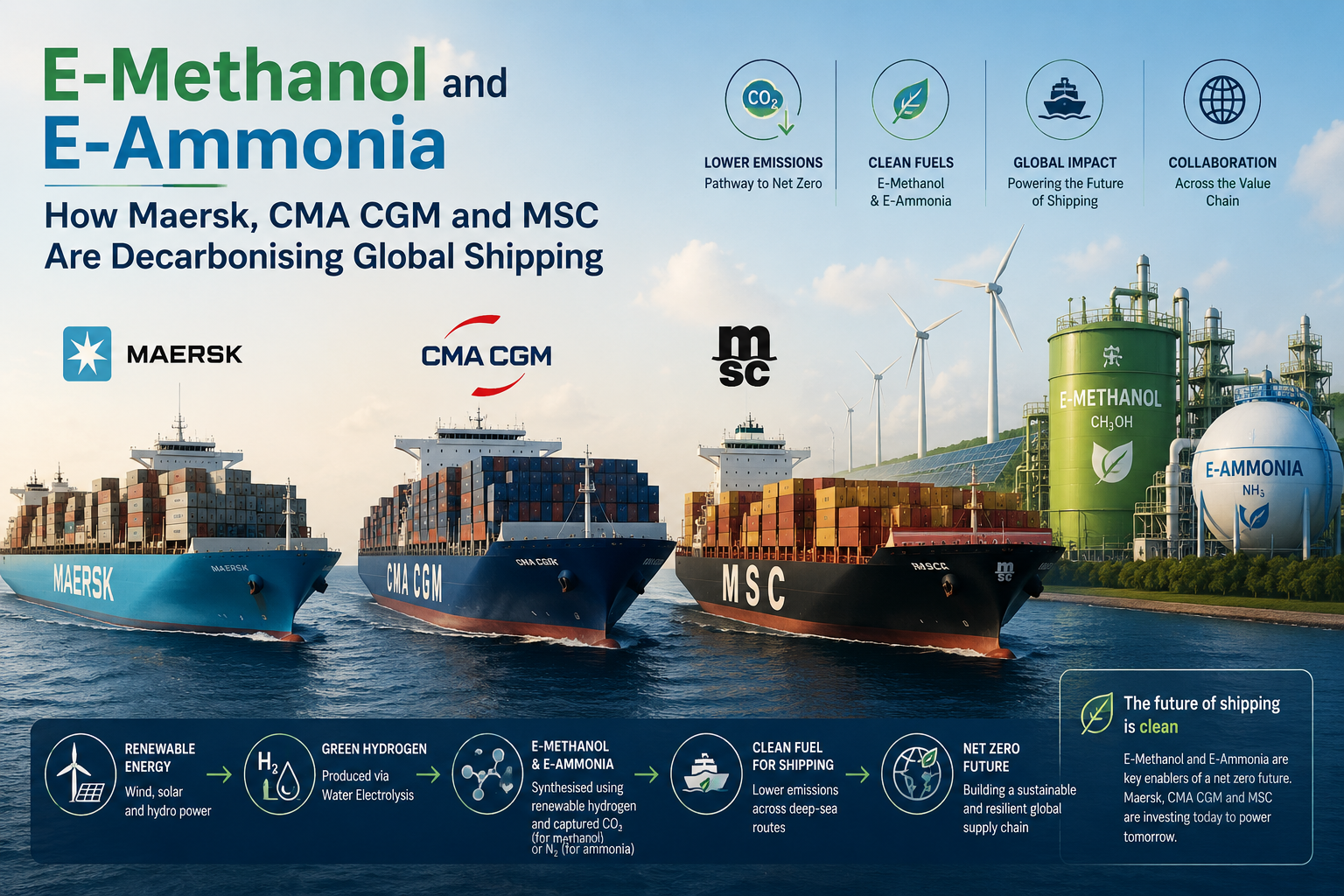

E-Methanol and E-Ammonia:
How Maersk, CMA CGM and MSC Are Decarbonising Global Shipping
Global shipping is responsible for approximately 3% of world greenhouse gas emissions — roughly equivalent to Germany’s total annual output. FuelEU Maritime entered into force in January 2025, requiring ships calling at EU ports to progressively reduce their GHG intensity. The three largest container carriers — Maersk, CMA CGM and MSC — have collectively ordered over 100 methanol dual-fuel vessels and are actively developing e-ammonia as the next step. This article maps the industrial transition underway.
FuelEU Maritime — The Regulatory Framework That Makes E-Fuels Mandatory
FuelEU Maritime is not a voluntary framework. It entered into force on 1 January 2025 and applies to all ships above 5,000 gross tonnes calling at ports in the European Economic Area — regardless of flag state. The regulation mandates a progressive reduction in the greenhouse gas intensity of onboard energy on a well-to-wake basis: 2% reduction by 2025, tightening to 6% by 2030, 14.5% by 2035, and ultimately 80% by 2050 against a 2020 baseline.
In parallel, the EU has brought shipping into its Emissions Trading System. Since 2024, large ships calling at EU ports must surrender carbon allowances for their CO₂ emissions — with coverage expanding to 100% of intra-EU voyage emissions and 50% of emissions from voyages starting or ending outside the EU from 2026. The ETS cost alone is restructuring the fuel economics of European shipping routes.
- 2025 — 2% GHG intensity reduction vs 2020 · EU ETS 40% coverage · already in force
- 2026 — EU ETS 100% coverage for intra-EU voyages · 50% for international legs
- 2030 — 6% GHG intensity reduction · e-methanol and e-ammonia become economically competitive vs ETS penalty costs
- 2033 — End of 2× multiplier for e-ammonia · window to lock in early adoption contracts before incentive closes
- 2050 — 80% GHG intensity reduction · effectively requiring near-zero carbon fuels for the entire fleet
Maersk’s Bet — E-Methanol as the Core Strategy
A.P. Moller-Maersk made the earliest and most visible commitment to methanol in container shipping. The company ordered 19 methanol dual-fuel containerships as early as October 2022, with deliveries between 2023 and 2025. By 2026, Maersk operates the world’s largest fleet of methanol-capable container vessels. The fuel of choice is explicitly e-methanol — synthetic methanol produced from renewable hydrogen and captured CO₂, not fossil-derived methanol.
Maersk’s rationale is straightforward: methanol is liquid at ambient conditions, can be stored in standard-grade steel tanks with modest modifications, and is significantly easier to handle than liquefied hydrogen (-253°C) or ammonia (toxic, requiring specialised crew training and port infrastructure). Existing port infrastructure can be retrofitted for methanol bunkering at a fraction of the cost of cryogenic hydrogen or high-pressure ammonia storage.
The supply challenge is real and acknowledged by Maersk: biogenic CO₂, sustainable biomass and cheap renewable electricity are all in high demand from competing sectors. The company cannot assume unconstrained access to e-methanol at the volumes its fleet requires. This is precisely why Maersk has co-signed supply agreements with producers including European Energy (whose Kassø facility produces 42,000 tonnes of e-methanol per year) and continues to invest in securing dedicated supply chains.

CMA CGM’s Approach — LNG Bridge, Then Methanol
CMA CGM has taken a different but complementary path. The French carrier — which in January 2026 put its 400th owned ship into service, becoming the 11th ship in its fleet capable of operating on methanol — has built its transition strategy around LNG as a bridging fuel, with methanol as the next step. By 2031, CMA CGM plans to operate approximately 200 dual-fuel LNG and methanol-fuelled containerships.
In 2023, Maersk and CMA CGM announced a joint decarbonisation partnership — an unusual alliance between direct competitors, driven by the shared recognition that neither company can solve the fuel supply and standards challenges alone. The two groups committed to developing and maintaining standards for green methanol vessel operations, accelerating port readiness for bunkering, and jointly exploring e-ammonia as a future fuel pathway.
We want to accelerate the green transition in shipping and logistics and to do so, we need strong involvement from partners across the industry. When we unite through determined efforts and partnerships, a tangible and optimistic path towards a sustainable future emerges.
Vincent Clerc · CEO · A.P. Moller-MaerskE-Ammonia — The Next Frontier, and Why the 2× Multiplier Matters
E-ammonia (NH₃ produced from green or natural hydrogen and atmospheric nitrogen via the Haber-Bosch process) offers significant advantages over e-methanol for long-distance ocean shipping: higher energy density, no carbon content (zero CO₂ at point of combustion), and an existing global production and distribution infrastructure for the fertiliser industry. Its drawbacks are toxicity, the need for specialised handling and crew training, and the current immaturity of ammonia-fuelled marine engines at commercial scale.
FuelEU Maritime’s decision to grant a 2× multiplier to renewable fuels of non-biological origin used in fuel cells — which effectively applies to green and e-ammonia in fuel cell configurations — until 2033 creates a temporary but significant economic incentive to commit to ammonia now. A ship operator who locks in e-ammonia supply agreements and vessel orders before 2033 benefits from twice the regulatory credit per tonne of fuel consumed. After 2033, e-ammonia competes on equal terms.
| Fuel | Energy density | Infrastructure | FuelEU status | Key players |
|---|---|---|---|---|
| E-Methanol | 15.6 MJ/L | Easiest retrofit | Fully eligible · mandated | Maersk · CMA CGM · European Energy · CRI |
| E-Ammonia | 11.5 MJ/L | Specialised handling | 2× multiplier until 2033 | Yara · MAN Energy · Wärtsilä · MSC |
| Bio-LNG | 22.2 MJ/L | Existing infrastructure | Eligible · biomass limits apply | CMA CGM · MSC · Shell |
| E-Hydrogen | 8.5 MJ/L (liq.) | -253°C · high cost | Eligible · 2× multiplier fuel cells | Research phase · very few commercial orders |
The Natural Hydrogen Connection — How Lorraine Changes the Economics
Both e-methanol and e-ammonia are hydrogen-derived fuels. Hydrogen represents 60–70% of the production cost of e-methanol and a similar proportion for e-ammonia. At current green electrolytic hydrogen costs of €6–12/kg, both fuels remain expensive relative to fossil alternatives — even after ETS carbon costs are applied. The economics are marginal, and only regulatory mandates currently make them competitive.
If natural geological hydrogen from the Lorraine Basin — where FDE confirmed concentrations of 49.6% at 2,426 metres in June 2026, with first commercial production targeted for late 2028 — can be produced at €0.50–1.00/kg, the production cost of e-methanol and e-ammonia falls dramatically. At €0.50/kg H₂, e-methanol approaches cost parity with fossil methanol without any ETS subsidy. For maritime shipping, this is potentially transformational: it means the green premium disappears, and carriers no longer depend on carbon pricing to make the economics work.